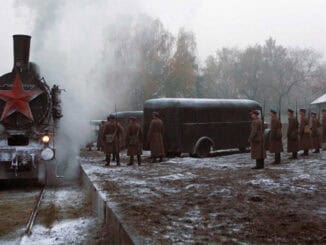
Photo: Re-enactment of the Battle of Warsaw at the site of its course in Ossów near Warsaw PHOTO by Filip Blazejowski: Forum forum-0428639170
Battle of Warsaw: Not a miracle, but the genius of Polish military strategy.
Patryk Palka
The Battle of Warsaw ranks among the greatest victories in the history of Polish arms. It safeguarded the independence regained in 1918 after 123 years of partition and helped shape the future of Poland as well as Central and Eastern Europe. Its impact reached far beyond the region, influencing the course of history across the entire continent.
The Polish-Soviet War is primarily examined within the years 1919 to 1921, although some historians argue that its roots trace back to the end of 1918. Following the conclusion of World War I, Soviet troops began occupying regions that had been vacated by the retreating Germans, specifically what are now Belarus, Ukraine, and the Baltic states. By January 1919, the Soviets had established control over key cities such as Daugavpils, Minsk, and Vilnius. Their ambitions extended far beyond these territories; they sought to dominate all of Central and Eastern Europe and to propagate the communist revolution across the western and southern parts of the continent, eyeing countries like Germany, Hungary, and even Italy. Faced with this aggressive advance, Poland had no option but to mount a defence.
The newly reestablished Polish state undertook a monumental effort to mobilise its military forces. Through a combination of voluntary enlistment and conscription, the Polish Army managed to recruit nearly 950,000 soldiers by September 1920, with around 350,000 deployed directly on the front lines while the rest served as reservists. In stark contrast, the Red Army boasted a total reserve of 5 million soldiers, with approximately 1 million actively engaged in the conflict against Poland.
Photo:www.gov.pl
Initially, the situation seemed promising for the Polish forces, as the chaos of the Russian Civil War allowed the Polish Army to advance eastward. However, as the Bolsheviks ultimately triumphed in their internal struggle around early 1920, the tide of war began to shift. A formidable Soviet counteroffensive forced the Polish forces to retreat, and by mid-August 1920, the Red Army was perilously close to the gates of Warsaw.
The circumstances on the front became increasingly dire. Although the Soviets were the aggressors with designs on conquering Europe, their propaganda successfully painted Poland as the imperialist antagonist. This narrative had significant repercussions; the League of Nations adopted a stance of neutrality, the United Kingdom declined to extend assistance to Poland, and Germany, seeking to capitalise on Poland’s plight, provided armaments and volunteers to the Soviet cause. While Hungary offered support to Poland, their efforts were stymied by Czechoslovakia, which seized the opportunity to occupy Trans-Olza. Across Europe, pro-communist and anti-Polish demonstrations proliferated. Many factions were convinced that the Soviet Union represented a transformative revolution capable of rejuvenating a continent reeling from the aftermath of World War I. Thus, on the eve of the pivotal Battle of Warsaw, Poland found itself nearly isolated. In July 1920, France did extend crucial support by dispatching several hundred seasoned officers to Warsaw, but little more could be expected from the West.
So, how did the Polish forces manage to reverse the course of the war and emerge victorious against the Soviets? The outcome was not merely the result of chance; rather, it was a product of the strategic acumen of Polish commanders, the resilience and determination of the soldiers, and the exceptional will to fight exhibited by both the military and the civilian population. Critical to this success was the work of Polish cryptologists, led by officer Jan Kowalewski, who successfully decrypted Soviet communications and intercepted plans for an attack on Warsaw. This intelligence allowed Polish commanders to anticipate the Soviet maneuvers and respond effectively. Additionally, the General Staff of the Polish Armed Forces, under the guidance of General Tadeusz Rozwadowski, formulated a strategy to halt the Soviet advance and initiate a counteroffensive. Various operational plans were presented to Commander-in-Chief Józef Piłsudski, who selected those that would be executed. Marshal Piłsudski also took direct command of the manoeuvre units involved in the counterattack.
The battle on the outskirts of Warsaw commenced on 13 August. In the initial phase, the Polish forces successfully repelled the Soviet assault, and on 16 August, they launched a counteroffensive from the Wieprz River, outflanking the Soviets and striking at their rear. The Polish forces managed to capture a Soviet radio station, disrupting the Red Army’s communications and causing confusion among Soviet troops, who instead heard biblical readings from Polish soldiers in place of military orders. This disarray compelled the Soviets to retreat, leading to a pursuit that inflicted substantial losses on their forces. By August 25, the Battle of Warsaw had concluded in favour of the Poles, altering the trajectory of the entire war. Poland not only safeguarded its independence but also shielded the rest of the continent from the encroachment of Soviet totalitarianism. In this light, the Battle of Warsaw is rightly regarded as one of the decisive battles in world history. Without this victory, Poland might have vanished from the map, along with Lithuania, Latvia, and Estonia, and potentially Finland, Romania, and Czechoslovakia, with Hungary following suit. Millions of citizens in these nations could have faced brutal repression in the name of revolution. The further spread of communism to the West posed a significant threat of igniting another world war far earlier than it ultimately occurred, with consequences that are impossible to fully foresee.
Patryk Palka
A historian dealing with the history of political thought and the history of ideas. Editor of the Warsaw editorial office of the monthly magazine and portal „Everything That Is Most Important.”
Source: dlapolonii.pl