First year of Nawrocki’s presidency, Poland’s growing economy, Russian airspace violations on NATO’s eastern flank, and exclusive reports from Narva and the Suwałki Gap — newsletter for August 2026.
President Karol Nawrocki Marks First Year in Office
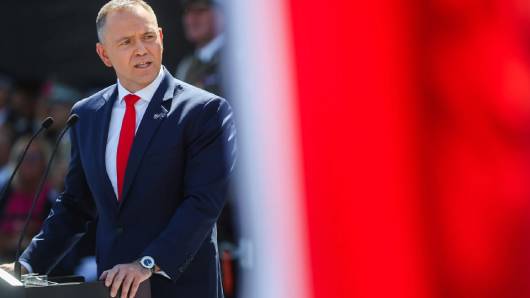
President of Poland Karol Nawrocki
August 6 marked one year since Karol Nawrocki took office as President of Poland. A year into his five-year term, Nawrocki maintains substantial public support. An August poll found that 56 percent of Poles viewed his presidency positively, compared with 40.5 percent who rated it negatively. Other surveys conducted around the anniversary also showed more positive than negative assessments, although views of the president remain strongly divided along political lines. Nawrocki ran with the support of the main opposition party, Law and Justice (PiS).
Poland’s president is directly elected by popular vote. Unlike the largely ceremonial heads of state found in many parliamentary democracies, Poland’s president has significant constitutional powers. He is commander-in-chief of the armed forces, represents the state in foreign affairs, appoints ambassadors, ratifies international treaties, appoints judges, can initiate legislation, and signs bills into law or vetoes them.
This constitutional division of executive power has resulted in a difficult cohabitation with the current government led by Donald Tusk. After Nawrocki’s first year in office, this institutional division has become a defining feature of Polish politics. Major decisions in several areas of state policy require cooperation – or at least accommodation – between the conservative president and the left-liberal government.
Polish Economy Grows, but Fiscal Deficit Remains High
Poland’s economy continued to expand at a solid pace in the second quarter of 2026. According to Statistics Poland, GDP grew by 3.9 percent year-on-year, up from 3.3 percent in the same quarter of 2025. On a seasonally adjusted basis, the economy expanded by 1.0 percent from the previous quarter.
At the same time, Poland is facing a significant fiscal imbalance. The government’s draft budget for 2027 projects revenues of PLN 695 billion ($187 billion) and expenditures of PLN 977.6 billion ($263 billion), leaving a central government budget deficit of PLN 282.6 billion ($76 billion). The broader general government deficit is expected to remain at 7.1 percent of GDP, one of the highest levels in the European Union. Poland has been subject to the EU’s excessive deficit procedure since 2024.
High defense spending is a major contributor to the fiscal pressure. Poland plans to spend PLN 198 billion on defense in 2027, more than 4.5 percent of GDP, as large-scale deliveries of military equipment continue. The government forecasts economic growth of 3.0 percent and inflation of 2.8 percent next year.
Russian Airspace Violations on NATO’s Eastern Flank
NATO condemned a series of recent Russian airspace violations along its eastern flank, including incidents in Poland and Romania. On August 12, the North Atlantic Council met to discuss the incidents and stated that Russia bears “full responsibility” for the violations, describing them as dangerous and unacceptable and as evidence of Moscow’s increasing willingness to take risks. NATO reaffirmed that it would defend Allied territory and continue strengthening air and missile defenses from the Baltic Sea to the Black Sea.
The meeting followed a July 30 incident in Poland, when a Russian missile entered Polish airspace and exploded in the eastern part of the country. Romania has faced repeated incursions as well. On August 16, a Spanish F-18 operating as part of NATO’s air policing mission shot down a suspected Russian drone after it entered Romanian airspace from Moldova. It was the fourth such incident in Romania in 2026. Earlier in August, Romanian military divers also destroyed two drones found drifting near the Neptun Deep offshore gas project in the Black Sea.
The incidents have heightened concerns across NATO’s eastern flank. Poland and the Baltic states have increased protection of critical infrastructure, including power plants, dams, and energy facilities, amid intelligence warnings that Russia could use captured Ukrainian drones in false-flag operations designed to create confusion within NATO.
Despite the increase in Russian hybrid activity and attacks on Ukraine, NATO said at the end of August that it did not see an imminent threat of a direct Russian attack on the Alliance. The incidents nevertheless underscore the growing challenge of protecting NATO territory against drones, missiles, sabotage, and other actions that remain below the threshold of conventional military aggression.
Michta: This Is Phase Zero of War
“We should not describe Russia’s actions against us as ‘hybrid warfare.’ Russia is testing the capabilities of a NATO state, observing how we respond to its provocations, and gathering information to plan an attack. This is phase zero of war,” Andrew A. Michta tells Igor Janke in an interview for Kanał Otwarty (in Polish).
Former Minister Nominated to Constitutional Tribunal
Maciej Berek, until mid-August a minister in Prime Minister Donald Tusk’s government and one of his closest aides, has been nominated by lawmakers from Tusk’s Civic Coalition (KO) for a seat on Poland’s Constitutional Tribunal. Tusk publicly backed his candidacy.
The nomination has drawn criticism because Tusk and his political allies came to power in 2023 promising to restore the independence of the Constitutional Tribunal after years of criticizing its politicization under the previous Law and Justice (PiS) government. Moreover, the governing majority’s own proposed reform of the Tribunal included a four-year cooling-off period before former government ministers could become Constitutional Tribunal judges. Berek left the government only days before his candidacy was announced.
Nine civil society organizations advocating for judicial independence and the rule of law have called on Berek to withdraw. They stressed that they do not question his professional qualifications but object to his immediate transition from a senior government position to the Tribunal. The organizations warned that restoring the rule of law cannot mean replacing one political camp’s influence over the Constitutional Tribunal with another’s.
Narva – NATO’s Last City Before Russia
Journalists Igor Janke and Grzegorz Ślubowski travelled to Narva, an Estonian city directly on the Russian border. They report from one of the most sensitive places on NATO’s eastern flank, speaking with local residents and examining how the city’s predominantly Russian-speaking population views Estonia, Russia, and the war in Ukraine. The program also explores disputes over Soviet historical memory and asks whether Narva could become a target of Russian destabilization in the future.
Igor Janke and Grzegorz Ślubowski visited the Suwałki Gap along the Polish-Lithuanian and Polish-Belarusian borders, NATO’s only land connection between the Baltic states and the rest of the Alliance. Col. Maciej Korowaj explains why Russia would not necessarily have to seize the corridor to create a major problem for NATO. Fire control, drones, artillery, and strikes against logistics could be enough to disrupt this vital route.
REMARKS BY PRESIDENT TRUMP AND VICE PRESIDENT VANCE AT LIBERTY BALL Union Station Washington, D.C. (January 21, 2025) THE VICE PRESIDENT: How we doing? (Applause.) Isn’t it a great day to make the 45th […]
President Andrzej Duda. 2025 NATO Summit The Hague President Andrzej Duda has praised NATO’s long–awaited move to ramp up the recommended defence spending level from 2 percent to 5 percent, saying the new threshold aligns […]
Quigley Travels to Poland Quigley met with Polish leaders and U.S. troops Washington, DC – Today, U.S. Representative Mike Quigley (IL-05), Co-Chair of the Congressional Ukraine Caucus, released a statement on his recent visit to […]
Polishnew.com "America's leading Polish Bilingual Protal since 1997, promoting Polish-American culture, heritage, and uniting Polish communities around the globe."