
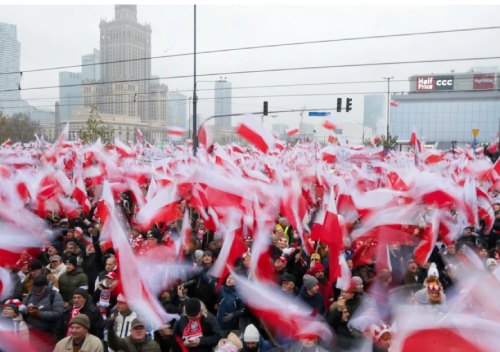
Independence Day march in Warsaw, Poland, on November 11, 2026/https://newsmaxpolska.pl
November 11 – Polish Independence Day: 108 Years Ago Poland Returned to the Map
On November 11, 1918, Józef Piłsudski took command of the army and, after 123 years of partitions, Poland returned to the map of Europe. How Piłsudski, Paderewski and Polish Americans won independence.
On November 11, Poles around the world celebrate National Independence Day. On that day in 1918, the Regency Council handed command of the army to Józef Piłsudski, and after 123 years of partitions, Poland returned to the map of Europe. This year marks the 108th anniversary.
On the same day, in a forest clearing near Compiègne, France, the armistice that ended World War I was signed. The three empires that had carved up the Polish-Lithuanian Commonwealth at the end of the 18th century – Russia, Prussia and Austria – lay in ruins. Poles seized the moment because they were ready for it.
123 years without a state
After the third partition in 1795, Poland disappeared from the map. For more than a century there was no Polish government, no Polish army and no Polish currency. What remained was the language, the faith, the literature and the memory of the November and January Uprisings. That is why in 1918 a nation that had lived under foreign rule for five generations was able to rebuild its own state within weeks.
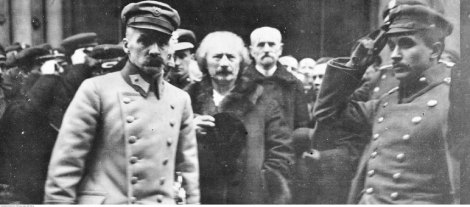
Józef Piłsudski (left) and Ignacy Jan Paderewski (second from left) in Warsaw in February 1919, on the day of the ceremonial opening of the Legislative Sejm, after Mass at St. John’s Cathedral. Behind them is Interior Minister Stanisław Wojciechowski; on the right, the Chief of State’s aide-de-camp Lt. Tadeusz Kasprzycki salutes. Photo: National Digital Archives of Poland (22-241-1), public domain.
Piłsudski and Paderewski: two roads to one goal
Józef Piłsudski believed independence had to be won by force of arms. He created the Polish Legions, and after refusing to swear loyalty to Germany, he was imprisoned in Magdeburg. He returned to Warsaw on November 10, 1918. A day later he took command of the army, and on November 22 he became Provisional Chief of State.
Ignacy Jan Paderewski fought differently. The most famous pianist of his time, adored in America, he turned concert halls into a platform for the Polish cause. He played, spoke and raised money for war victims in Poland. He also won over President Woodrow Wilson. In January 1918 Wilson announced his Fourteen Points; the thirteenth called for an independent Polish state with access to the sea.
In late December 1918, Paderewski’s arrival in Poznań sparked the Greater Poland Uprising. In January 1919, Piłsudski appointed him prime minister and foreign minister, and on June 28, 1919, Paderewski and Roman Dmowski signed the Treaty of Versailles on behalf of Poland. The two men disagreed on a great deal, but at the decisive moment they worked together. In the photograph from February 1919 they walk side by side to the opening of the first parliament of the reborn Republic.
Independence won in America, too
Polish Americans did not sit on the sidelines. More than 20,000 volunteers from the United States enlisted at a training camp in Niagara-on-the-Lake, Canada. From there they sailed to France to join General Józef Haller’s Blue Army, which reached Poland in 1919 and became part of the Polish Army. Polish parishes and organizations from New York to Chicago collected money, food and clothing for the homeland.
That bond has endured. The heart of Ignacy Paderewski, who died in New York in 1941, rests at the National Shrine of Our Lady of Czestochowa in Doylestown, Pennsylvania – the “American Czestochowa,” about a two-hour drive from New York City.
A holiday that could not be celebrated
November 11 became an official state holiday only in 1937. After World War II the communist authorities abolished it, and for decades the anniversary of independence could only be marked quietly – or in exile. The Polish parliament restored National Independence Day in February 1989, shortly before the fall of communism.
Today white-and-red flags fly across Poland and in Polish American homes. In New York, the Józef Piłsudski Institute of America in Greenpoint marks the anniversary with an open house, a film screening and a Chopin recital. It is a good day to tell our children and grandchildren where we come from – and what the freedom we now take for granted once cost.
Source: https://poland.us/en
Thousands Out On The Streets For Poland’s Independence Day March / 2026
https://www.youtube.com/watch?v=hKOFJziyo14
LIVE: Far-right march draws thousands in Warsaw
https://www.youtube.com/watch?v=bf6GgVTAYE4


