
Poland needs bipartisan lobbying in the USA. Paderewski Institute and the new role of Polonia.
Waldemar Biniecki
Poland cannot build its international position solely on the strength of its economy, military potential, and official diplomatic relations. In a world where decisions made in Washington directly affect the security of Poland and Europe, the future of NATO, and the balance of power on the continent, we also need a durable capacity to influence the American decision-making process. One of the most important, yet still insufficiently utilized, instruments of Poland’s raison d’état is American Polonia.
For years, in my publications, I have posed the question: why does a community numbering millions of Americans of Polish descent not have a properly organized, professional, and bipartisan mechanism for representing interests connected with Poland? Why does the demographic, economic, intellectual, and social potential of Polonia not translate more strongly into its presence in the American strategic debate?
This is not a question about a lack of patriotism or commitment. It is a question of organization, strategy, financing, and the capacity for long-term action.
In my articles devoted to pro-Polish lobbying, Poland’s relations with the diaspora, and the search for Poland’s raison d’état, I have consistently pointed to the need to move from scattered initiatives to systemic action. Today I would like to expand this concept with two mutually complementary elements: the creation in Washington of a Polish think tank under the name Paderewski Institute and the building of a network of coordinated civic diplomacy cooperating with it.
From potential to political agency
American Polonia has enormous social capital. It is made up of citizens of the United States active in business, academia, administration, the military, law, technology, and the media. Many of them know American institutions from the inside, understand the mechanisms of Congress and the federal administration, and also have contacts that cannot be replaced by an occasional visit from a Polish delegation.
However, it is not enough to count on the individual successes of Americans of Polish descent automatically translating into benefits for Poland. Potential becomes power only when it is organized around clearly defined goals, supported by professional expert backing, and equipped with tools enabling a constant presence in decision-making institutions.
That is precisely why I have for years advocated building professional, pro-Polish lobbying in the United States. This is not about activity against anyone or an attempt to subordinate American policy to Polish expectations. It is about representing Poland’s legitimate interests in a way understandable to American decision-makers, while taking into account the security and development interests of the United States.
We cannot expect that the size of Polonia alone will ensure influence for Poland. We need institutions that will make it possible to turn this potential into knowledge, relationships, initiatives, and concrete results.
Why must this lobbying be bipartisan?
The most important condition for the success of such action is bipartisanship.
Poland’s raison d’état cannot depend on which party holds power in Warsaw, nor on whether the White House is occupied by a Republican or a Democrat. Poland’s strategic interests should be communicated consistently, regardless of the electoral calendar and political changes.
That is why we need professional relations with both the Republican Party and the Democratic Party. We need contacts with members of Congress, senators, the federal administration, state authorities, analytical centers, and opinion-forming circles. We need people who will present the Polish position not only in times of crisis, but also when Poland is not at the center of American media attention.
Bipartisanship does not mean giving up one’s own views. It means the ability to develop a catalog of common interests that can become the subject of cooperation among politicians of different orientations.
The security of NATO’s eastern flank, a permanent base of American troops in Poland, the stability of Poland and Europe, the development of energy cooperation (Polish nuclear energy and the LNG gas network), transatlantic economic ties, and countering threats from states pursuing revisionist policies are issues on which Poland can present arguments that matter also to American citizens, including Americans of Polish descent. I also remind readers that among the American troops stationed in Poland are also our children—Americans of Polish descent—whom we cannot forget.
However, we cannot limit ourselves to repeating that Poland is America’s faithful ally. We must be able to demonstrate what specific benefits cooperation with Poland brings to the United States.
Let us learn the mechanisms, not copy other people’s organizations
In the American political system, numerous organizations represent the interests of specific communities, sectors of the economy, and ethnic groups. Their experience shows that effective representation requires stable financing, expert backing, consistent communication, and the ability to build coalitions. An example for us may be the “Hungary Foundation,” financed by small Hungary.
In my publications, I have drawn attention, among other things, to the activities of AIPAC and other lobbying organizations. This is not about mechanically copying their structures or methods, but about understanding that political influence is the result of many years of systematic work.
We need our own model, suited to Polish capabilities and American realities. A model based on transparency, professionalism, independence, and responsibility.
Pro-Polish lobbying should have a team preparing legislative analyses, monitoring decisions of the administration and Congress, organizing meetings with politicians, and presenting concrete proposals for solutions. It should cooperate with experts in security, energy, the economy, and foreign policy. It must also have the ability to respond quickly to events that may affect Poland’s interests.
We will not create such a structure through one conference, a ceremonial declaration, or an occasional visit to Washington. This is a project requiring many years of consistency.
Paderewski Institute — a Polish think tank in Washington
One of the most important elements of the model I propose should be the creation in Washington of a professional Polish analytical center under the name Paderewski Institute.
Its task would be to develop strategic Polish-American relations through research, analysis, expert dialogue, and cooperation with American institutions. It should not be merely another place for organizing conferences about Poland. It should become a center that understands the American decision-making process and can present Polish interests in the language of arguments, data, and concrete proposals.
The name refers to Ignacy Jan Paderewski, who understood that the struggle for Polish independence and sovereignty required not only diplomatic efforts, but also the ability to persuade American elites, mobilize public opinion, and build social support for the Polish cause. Paderewski was able to combine political activity, personal authority, and the engagement of Polonia in the service of independence. Today we need a modern continuation of this tradition.
Paderewski Institute should be an intellectually independent institution, open to cooperation with various political circles and capable of conducting its work for decades to come. Its credibility should stem from the quality of its research, the reliability of its analyses, and the durability of its relationships, not from the current political configuration in Warsaw or Washington.
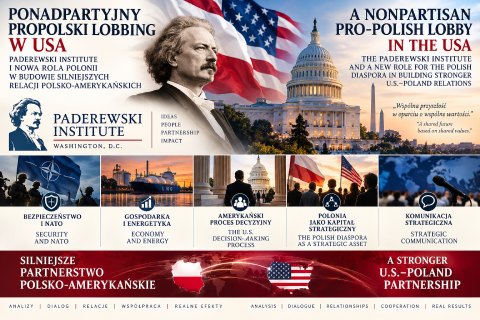
The Institute’s program should cover five basic areas.
First — security and NATO. Analyses concerning the strategic importance of Poland, Central and Eastern Europe, and NATO’s eastern flank for the security of the United States. The center should develop cooperation with experts in defense, foreign policy, and transatlantic security.
Second — economy and energy. Research and projects concerning LNG, nuclear energy, infrastructure, the defense industry, new technologies, and bilateral investment. Poland should be presented as a partner offering concrete opportunities for economic and technological cooperation.
Third — the American decision-making process. Monitoring legislative initiatives, preparing analyses for decision-makers, organizing expert briefings, and developing relations with members of Congress, the federal administration, and state authorities.
Fourth — Polonia as strategic capital. Researching the potential of Americans of Polish descent, creating networks of experts and leaders, and developing programs for the younger generation, which may in the future participate in the public, academic, and economic life of the United States.
Fifth — strategic communication. Preparing English-language reports, analyses, and informational materials that will allow the American public to better understand Poland, its interests, and the importance of Polish-American cooperation. Cooperation with American and Polish media.
Paderewski Institute should publish short analyses for decision-makers, strategic reports, and recommendations concerning specific problems. It should organize expert meetings, public debates, and briefings for representatives of both political parties. Its role would also be to connect American and Polish specialists, entrepreneurs, and research institutions.
This is not about creating a propaganda tool or uncritically justifying every decision of the Polish authorities. A credible think tank must maintain independence and base its positions on reliable sources. Only in this way can it gain the trust of American audiences and become a lasting participant in the strategic debate.
Civic diplomacy — from analyses to coordinated action
A think tank alone is not enough. Even the best studies will not change reality if they remain on library shelves or in internet archives.
That is why Paderewski Institute should cooperate with a network of coordinated civic diplomacy that would translate expert knowledge into conscious, lawful actions by citizens and organizations.
Civic diplomacy does not replace state diplomacy. It complements it with social rootedness, competencies, and relationships that cannot be built solely through official visits.
Americans of Polish descent are citizens of the United States. They can participate in public debate, present their positions to elected representatives, engage in the activities of social and professional organizations, and build coalitions around issues they consider important for their country and for relations with Poland.
This potential should be developed in an organized, professional, and bipartisan way.
In the proposed model, Paderewski Institute would provide analyses, data, and recommendations, while the civic diplomacy network would make it possible to use them in practice.
The mechanism of action could proceed in five stages.
-
Problem identification. The Institute identifies a decision, legislative proposal, or strategic issue important to Polish-American relations.
-
Preparation of arguments. Experts prepare short analyses in English, data summaries, and proposals for possible solutions.
-
Coordination of communities. Polish diaspora organizations, specialists, entrepreneurs, and local leaders receive materials and the opportunity to participate in consultations.
-
Civic dialogue. Participants hold meetings with representatives of Congress, the administration, and state authorities, presenting arguments and recommendations.
-
Evaluation of results. The Institute analyzes the reactions of decision-makers, monitors the further course of the matter, and publishes a summary of the activities.
This is not about creating a centrally controlled structure or issuing orders to Polonia organizations. It is about voluntary coordination around agreed goals, while preserving the autonomy of participants and the transparency of their activities.
Such a network could include security experts, lawyers, economists, representatives of industry, academic circles, Polonia organizations, and young leaders. Particularly important would be building relations with Americans who do not have Polish roots but recognize the importance of cooperation with Poland for security, the economy, and transatlantic stability.
Effective civic diplomacy also requires training participants in the functioning of Congress, the preparation of policy documents, public communication, and the principles of legal lobbying. We need people who not only identify with Poland, but can also competently present arguments in the American public sphere.
The Polish American Congress needs strategic modernization
A special place in this debate is occupied by the Polish American Congress. The PAC was established in 1944 as a platform for uniting Polish communities in the United States around the cause of Polish independence. Its history proves that Polonia was able to mobilize at pivotal moments.
Today we need another stage of development.
In my proposal Development Strategy of the Polish American Congress 2025–2030, I pointed to the need to move away from a model based primarily on tradition, organizational structures, and anniversary events toward an organization capable of professionally representing the interests of Polonia and Poland.
The PAC could become an important platform for coordinating Polonia activities, provided that it develops its competencies, opens itself to new generations, and cooperates with independent experts, entrepreneurs, and organizations operating at the level of individual states.
In this model, Congress could cooperate with Paderewski Institute as one of the main partners representing organized Polonia communities. The Institute would provide analytical support, while the PAC and other organizations would participate in consultations and civic activities.
This would not mean subordinating all organizations to one institution. On the contrary, the strength of such an undertaking would result from combining different competencies while preserving the autonomy of participants.
We need a permanent base in Washington, a professional public affairs team, a program of cooperation with Congress and the administration, systematically prepared analyses in English, and a transparent budget.
This is not about another label. It is about an efficient structure capable of operating for many years.
Warsaw–Paderewski Institute–Polonia–Washington
Poland’s policy toward the diaspora requires a change in philosophy.
For years it has too often been reduced to financing selected initiatives, supporting cultural activities, and maintaining historical ties. These are important tasks, but they do not exhaust the possibilities of cooperation.
We need to move from management to coordination, from grants to investing in agency, from a policy toward Polonia to a policy together with Polonia.
The model I propose is based on four complementary elements.
Warsaw is responsible for formulating the long-term goals of Polish foreign policy, conducting official diplomacy, and creating conditions for cooperation.
Paderewski Institute develops analytical support, studies American political conditions, prepares recommendations, and builds expert relationships.
Polonia contributes knowledge about American society and institutions, professional competencies, a network of contacts, and the ability to conduct civic dialogue.
Washington remains the space in which official diplomacy, expert knowledge, and civic activity can meet within the democratic decision-making process.
Such a model requires institutional independence and a clear division of responsibilities. The Polish state should not direct American civic organizations, and Polonia organizations should not replace Polish diplomacy. Their cooperation must be based on partnership, transparency, and agreed goals.
What is needed are regular strategic consultations, joint expert projects, personnel development programs, and a mechanism ensuring continuity of action regardless of political changes in Poland.
It is not enough to react to successive crises. We must build a system that also functions when there is no urgent need for mobilization.
Security, energy, and the economy — concrete areas of cooperation
Pro-Polish lobbying cannot be limited to symbolism, history, and patriotic ceremonies. It must have a concrete program.
The first area is security. Poland needs durable relations with American institutions responsible for defense, as well as dialogue concerning military presence, infrastructure, cooperation between defense industries, and the security of NATO’s eastern flank.
The second is energy. Polish-American cooperation in LNG supplies, nuclear energy, technology, and energy infrastructure shows that strategic interests can go hand in hand with concrete economic benefits.
The third area is the development of business and technological relations. Polish and American enterprises should have better opportunities to establish cooperation, and Polonia business circles can serve as a bridge between markets.
The fourth is strategic communication. Poland needs a stronger presence in the American public debate—based on reliable knowledge, professional analyses, English-language media, and cooperation with experts.
Paderewski Institute could integrate these areas into one analytical program. Each of them should have its own goals, responsible persons, and a way of measuring results. Effectiveness should be assessed not by the number of conferences organized, but by real effects: political initiatives, lasting institutional relationships, the development of economic cooperation, and the presence of Polish arguments in the decision-making process.
Who should finance this system?
Professional representation of interests requires stable financing. It cannot rely solely on the volunteer work of activists or occasional fundraising.
What is needed is a model combining membership contributions, private donations, foundation support, and lawful funds for specific programs. Transparent financing rules, independent audits, and a clear separation of lobbying activity from cultural, educational, and charitable programs are essential.
Paderewski Institute should develop its own transparent financial structure. Cooperation with Polish public institutions, foundations, enterprises, and private donors must take into account the independence of analyses as well as the regulations in force in the United States concerning non-profit organizations, lobbying activity, and the representation of foreign interests.
It is also important to engage the younger generation of Americans of Polish descent. We need internship programs, training, mentoring, and networks of contacts that will enable young people to participate consciously in public life. In the future, Paderewski Institute could run programs preparing a new generation of experts and leaders to work in the areas of foreign policy, security, the economy, and civic diplomacy.
Polonia as a strategic pillar of Polish-American relations
Polonia is not merely a community of memory. It should not be perceived only through the prism of history, folklore, or anniversary events. It is also social, economic, and intellectual capital that can play a significant role in relations between Poland and the United States.
In my concept of Pax Polonica, sovereignty, security, and culture constitute the basic pillars of a responsible international order. Poland, if it wants to help shape such an order, must know how to use all available instruments of action—including the potential of its own diaspora.
This is not about building Polish dominance or competing with other communities. It is about responsible participation in the public life of the United States, building coalitions, and presenting arguments in favor of cooperation with Poland.
This also requires a change on Warsaw’s side. Polonia should be included in strategic thinking about Polish foreign policy. Its experience, competencies, and contacts cannot be used only ad hoc, in times of crisis.
We need a lasting partnership that will connect Poland’s raison d’état with the activity of citizens of Polish descent operating within the American democratic system. Paderewski Institute could provide this partnership with intellectual support, and coordinated civic diplomacy with a practical dimension.
Time for a decision
We do not lack historical examples of effective mobilization by Polonia, nor people who understand the importance of Polish-American relations. What we lack above all is a properly coordinated system that would make it possible to translate these resources into long-term agency.
That is why I propose launching a broad debate on the creation of a bipartisan platform for pro-Polish lobbying in the USA, whose important elements would be Paderewski Institute and a cooperating network of civic diplomacy.
The first step should be to agree on a common catalog of interests, prepare an action plan for several years, and create a professional base in Washington. Subsequent stages should include the development of the think tank, a network of experts, training programs, permanent relations with politicians of both parties, as well as a system of financing and evaluation of results.
We cannot expect that the size of Polonia alone will ensure influence for Poland. Nor can we assume that traditional Polish-American friendship will be a sufficient guarantee of the realization of our interests.
Friendship between states requires cultivation, an alliance requires work, and political influence requires organization.
Poland needs not only bipartisan lobbying, but also its own intellectual base in Washington and throughout the United States. Paderewski Institute and the civic diplomacy network cooperating with it could combine strategic analysis with the practical activity of Polonia, creating a lasting mechanism of cooperation among Warsaw, American Polonia communities, and Washington.
This is not about creating yet another organization for the sake of organization itself. It is about building a lasting capacity to represent Polish interests in the world’s most important political center—with the coming decades in mind, not the next political term.
Waldemar Biniecki
Columnist, editor-in-chief of Kuryer Polski


