
Poland: Tusk’s government moves against TV Republika, an independent-minded broadcaster
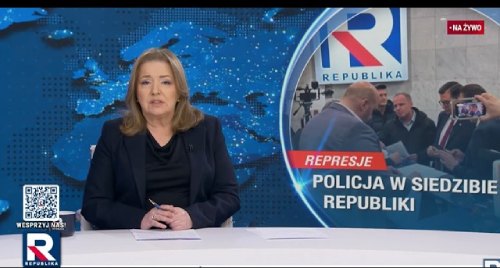
After targeting the judiciary, the authorities have now turned to journalists: Polish police raided the headquarters of the conservative outlet TV Republika, just one day after Independence Day. This is the latest step in Donald Tusk’s campaign to seize and purge state institutions—all in the name of restoring the „rule of law.”
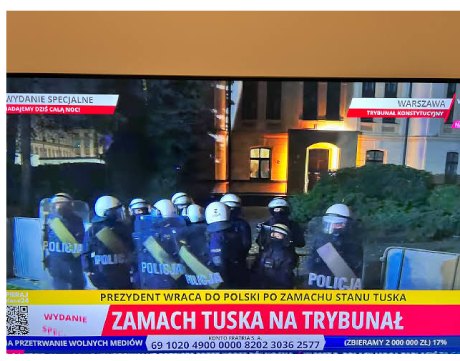
Photo/ Facebook
Poland: Tusk’s “soft coup” now threatens press freedom as well. In the last three days, the Supreme Court has overturned the dismissal of the Constitutional Tribunal’s leadership, 250,000 Poles have marched with President Nawrocki, and the public prosecutor’s office has targeted the “conservative” broadcaster TV Republika. And Brussels remains silent. The Polish “soft coup” did not end with the siege and occupation of the Constitutional Tribunal. On October 30, the police surrounded the building to allow judges appointed by the Sejm to enter, suspend President Bogdan Święczkowski and Vice President Bartłomiej Sochański, and entrust the leadership of the body to Anna Korwin-Piotrowska. Now that the country’s highest court has condemned the operation, the government is ignoring the decision and increasing pressure on the media outlets that reported on the events. This is not a chronicle of Chinese repression in Hong Kong; we describe the events taking place in Poland under the shame of the “European People’s Party”: Donald Tusk.
On November 10, the Supreme Court overturned the suspensions of the president and vice-president of the Constitutional Court, and the government refuses to recognize its jurisdiction, revealing the true face of the restored “rule of law”: the majority chooses its sympathetic judges, the police ensure their swearing-in, and an inconvenient ruling is declared irrelevant. Is the law only valid when it ratifies Tusk’s will? President Karol Nawrocki, who had interrupted a visit to Senegal to appear before the Constitutional Court, participated on November 11 in the “March for Independence,” which drew hundreds of thousands of citizens (250,000-500,000), one of the most impressive mobilizations in recent Polish history, concluding without significant incident. The message was clear: “The Pole is master in Poland,” not a subject of Berlin or European bureaucracies. Nawrocki reminded everyone that sovereignty and independence cannot be divided up in partisan struggles and demanded that judges and courts serve the Constitution, not the whims of the moment. Prime Minister Tusk, on the other hand, chose a separate demonstration in Szczecin, near the German border, and then accused the head of state of dividing Poles by remaining in Warsaw. Unbelievable!
The response to the popular demonstration in the capital came the following morning. A search warrant was executed at the TV station Republika, where the public prosecutor’s office ordered a massive seizure of materials and a police operation at the headquarters. The newsroom maintains that the warrant pertains to documents and recordings protected by journalistic secrecy, used to reconstruct the “takeover” of the Constitutional Court. Republika speaks of repression, and although a detailed public statement from the prosecutor’s office regarding the nature, legal basis, and scope of the operation is still pending, suspicions of a punitive political operation are more than plausible. The context makes the alarm anything but a pretext. Republika is already the subject of government proceedings and complaints. A democratic government cannot use prosecutors and police to search a newsroom and track down the sources that have documented its own impositions. Journalistic secrecy is not a privilege: it allows citizens to learn about abuses of power.
The problem with this government, however, didn’t begin today; Tusk has defined his own approach as “militant democracy,” a term he uses to justify exceptional measures to correct abuses attributed to previous democratically elected PiS governments. It’s a circular and dangerous line of reasoning: legality is violated to “restore” legality, institutions are occupied to make them independent, a broadcaster is intimidated to protect democracy. It’s the logic of all administrative authoritarianism: not tanks in the streets, but decrees, prosecutors, police, and the preemptive delegitimization of the adversary.
Von der Leyen’s Brussels is not a neutral spectator. In 2024, the Commission closed the Article 7 procedure and unlocked access to tens of billions of euros based on the plan promised by Tusk, before the crucial reforms had even been approved. Today, faced with the crisis, it continues to invoke the Sejm’s (parliament’s) right to elect judges and European rulings against the former Court, without condemning with the same clarity the use of force and the rejection of the Polish Supreme Court’s judgment. It is this double standard that casts the Union’s “long toxic shadow” over Poland, as is happening with Hungary and the Fidesz opposition. This is precisely why the Polish test concerns all of Europe: if Brussels remains silent when authoritarianism bears the “pro-European” label, the rule of law ceases to be a principle and becomes a weapon against inconvenient governments. After the judges, now it’s the journalists’ turn. When will the voice be raised in Brussels in defense of democracy and freedom?
SOURCE:
Luca Volontè


